The Body and the Monad
Embodied ascension and conscious evolution — the path of integration, where practice becomes destiny and the many of the body remember the one.
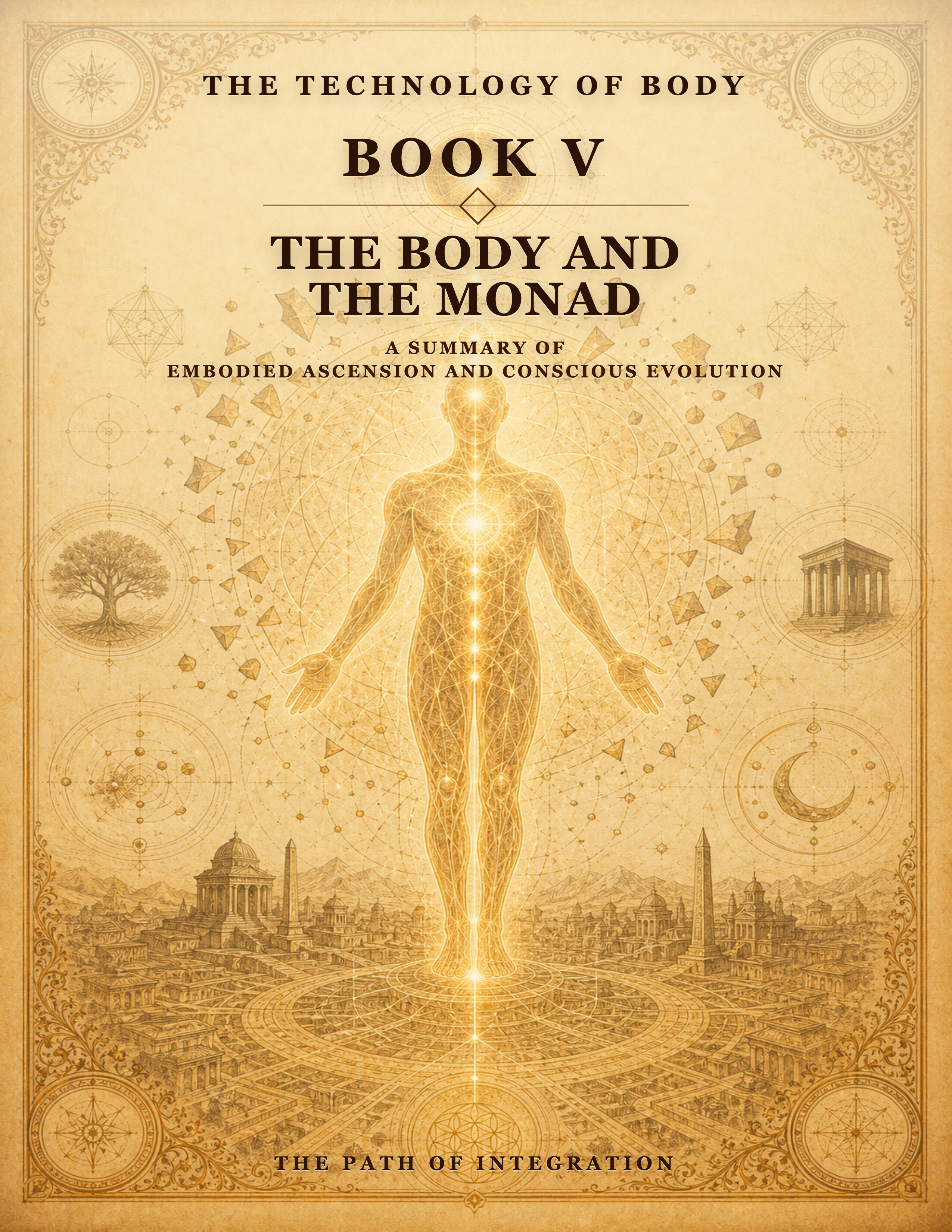
Book V opens at the threshold where practice becomes destiny.
Book I revealed the body as the original technology. Book II revealed the nervous system as the operating system of consciousness. Book III revealed the body as living symbol. Book IV revealed the methods by which the human being can be transformed through ritual, movement, desire, nourishment, fasting, discipline, and repeated embodied practice. Book V now asks what these technologies are ultimately serving. It asks what the body is being prepared to receive, carry, and transmit.
The answer is integration. The doctrine names this integration through the symbol of the Monad: the principle of unity, source, coherence, origin, center, and return. The Monad is not introduced as a dogma to be defended, but as a symbolic architecture for understanding wholeness. It points toward the reality that fragmentation is not the final truth of the human being. Beneath the divided mind, the defended body, the wounded identity, the scattered culture, and the overstimulated civilization, there remains a deeper call toward unity.
Book V does not treat ascension as escape from the body. It treats ascension as the reorganization of the whole human being toward coherence. The body is not abandoned on the path to the Monad. The body is the path made visible.
Breath, posture, chemistry, nervous regulation, attention, desire, speech, movement, memory, and relation all become instruments through which consciousness learns to return to center. The ascent is not upward flight alone.
It is inward ordering.
This is why the book begins with the fragmented self. Fragmentation is the condition in which parts of the human being cease to recognize one another. The mind says one thing while the body lives another. Desire moves in one direction while conscience moves in another. Speech announces truth while posture carries fear. Technology accelerates connection while the nervous system becomes more isolated. Civilization multiplies options while the soul loses orientation.
The fragmented self is not merely confused. It is divided by survival, trauma, imitation, overstimulation, shame, ambition, fear, and cultural design. A person may split from the body because the body carries pain. They may split from feeling because feeling once overwhelmed them. They may split from desire because desire became dangerous. They may split from spirit because spirit was distorted by domination or fantasy. They may split from community because belonging became unsafe. Fragmentation is often the intelligence of survival before it becomes the prison of identity.
Book V therefore approaches fragmentation without contempt. The divided self once found ways to endure. Dissociation, armoring, control, performance, numbness, analysis, fantasy, and withdrawal may have protected continuity when the organism had no better options. The doctrine refuses to shame these adaptations. Yet it also refuses to enthrone them. What once protected life can eventually prevent life from becoming whole. The wound explains, but it does not crown itself sovereign.
The modern world intensifies fragmentation because it trains the human being to live in multiple disconnected fields. The body sits while the mind scrolls. The image performs while the soul hides. The nervous system reacts to distant signals while the immediate room disappears. Work fragments time.
Media fragments attention. Markets fragment desire. Ideology fragments perception. Digital life fragments identity into profiles, metrics, comparisons, and projections. The self becomes a scattered parliament without a governing center.
Book V names this condition as spiritual and civilizational. Fragmented individuals build fragmented systems, and fragmented systems reproduce fragmented individuals. A school that trains memory without embodiment fragments learning. A workplace that extracts output while ignoring vitality fragments labor. A technology that captures attention while weakening presence fragments perception. A spirituality that praises transcendence while ignoring the nervous system fragments awakening. Civilization mirrors consciousness, and a divided consciousness builds divided worlds.
The first task of Book V is therefore remembrance. The fragmented self must remember that it is not only its pieces. It must remember body, breath, heart, mind, instinct, soul, shadow, lineage, environment, and purpose as parts of one field. This remembrance is not sentimental. It is labor. It requires honesty, discipline, grief, repair, and repeated return. The initiate begins to gather the scattered self without forcing premature unity.
Integration is the second movement. Integration does not mean perfection, purity, or the absence of conflict. It means relationship among the parts. The body begins to speak to the mind. The mind begins to listen to the body. Desire enters dialogue with purpose. Fear enters dialogue with courage. Wound enters dialogue with wisdom. Shadow enters dialogue with consciousness. Spirit enters dialogue with matter. Integration is the art of restoring conversation within the human field.
This is why coherence becomes sacred in Book V. Coherence is not flat calm.
It is ordered relationship. Breath aligns with attention. Attention aligns with feeling. Feeling aligns with discernment. Discernment aligns with action. Action aligns with purpose. Purpose aligns with service. Service aligns with the deeper field of life. When these levels begin to speak together, the human being becomes more than functional. The human being becomes transmissive.
Integration requires the body because the body reveals whether unity has become real. The mind can claim integration while the jaw remains locked, the breath remains shallow, the heart remains defended, the gut remains anxious, the voice remains false, and the movement remains collapsed. The body is the place where spiritual claims are tested. It does not accept abstraction as fulfillment. It asks whether the doctrine has become rhythm, posture, chemistry, gesture, and conduct.
The integrated human is not one who has eliminated the lower nature. The integrated human has brought instinct into right relationship with wisdom.
Appetite is not despised; it is educated. Power is not denied; it is governed.
Desire is not shamed; it is refined. Fear is not mocked; it is listened to and placed in proportion. Emotion is not drowned; it is metabolized. Spirit is not used to escape incarnation; it is allowed to enter the whole organism.
Book V therefore rejects false ascension. False ascension tries to rise by abandoning the body, bypassing grief, denying shadow, disowning desire, or imagining unity without repair. It may sound luminous, but the body remains divided. It may speak of source, but the nervous system remains organized around fear. It may praise love, but relationships remain immature. It may claim transcendence, but daily conduct remains fragmented. Book V asks for embodied transcendence, not spiritual performance.
Embodied transcendence means that the human being becomes more spacious without becoming less responsible. The initiate does not float above the world. The initiate becomes capable of holding more reality with coherence.
More grief without collapse. More power without domination. More complexity without panic. More beauty without possession. More intimacy without fear.
More solitude without abandonment. More service without self-erasure. This is ascension in the language of maturity.
The path toward the Monad is the third movement. The Monad represents unity before division and unity after integration. It is the symbolic center toward which the divided self returns, not by erasing difference, but by organizing difference into wholeness. A human being is not meant to become blank uniformity. The body contains many systems. The psyche contains many voices.
Civilization contains many functions. Unity is not sameness. Unity is right relation.
This distinction matters because many systems confuse unity with control.
They attempt to make the human being whole by suppressing complexity. They attempt to make civilization coherent by eliminating difference. They attempt to create order by silencing the body, the feminine, the shadow, the wound, the child, the dissenting voice, the inconvenient truth. Book V rejects this. The Monad is not tyranny. It is living center.
To move toward the Monad is to find the center that can hold multiplicity without fragmentation. The heart, the breath, the spine, the voice, the gut, the mind, the hands, the memory, the longing, and the wound all remain present, but they begin to orbit a deeper axis. The self no longer needs to be governed by whichever part is loudest. Appetite does not rule. Fear does not rule. Ego does not rule. Ideology does not rule. Wound does not rule. The integrated center begins to govern.
This is self-governance at its highest level. True leadership begins with self- governance because the one who cannot govern the inner field will project disorder into the outer field. The Monad within the human being is not a mystical decoration. It is the principle of ordered sovereignty. It asks whether the person can become internally ruled by wisdom rather than by impulse, fear, performance, appetite, resentment, or borrowed identity.
The path toward the Monad also requires shadow integration. The shadow is not simply evil. It is what has been rejected, hidden, exiled, denied, or left unconscious. It may contain destructive impulse, but it may also contain vitality, anger, grief, sexuality, creativity, tenderness, ambition, and power that were made unacceptable. The fragmented self often survives by exiling parts of its own life force. Integration requires retrieval without surrendering discernment.
Book V treats shadow as an initiatory threshold. What is unconscious governs indirectly. What is denied returns as symptom, projection, compulsion, ideology, resentment, fantasy, or sabotage. The initiate must learn to face what has been hidden without being consumed by it. Shadow work is not indulgence.
It is responsibility. The goal is not to act out every buried impulse. The goal is to bring the hidden into relationship with conscience, body, and purpose.
The body assists this work because the shadow is not held only in thought. It appears in breath, posture, tension, numbness, heat, repulsion, attraction, fantasy, avoidance, and reaction. The body knows what the persona denies. It contracts around forbidden truths and energizes around unclaimed powers. To approach the Monad, the initiate must become honest enough to feel what has been exiled and wise enough to integrate it without making it king.
This is also where Sophia becomes indispensable. Without Sophia, integration can become rigid self-command. Sophia brings beauty, receptivity, relational intelligence, tenderness, harmony, and the capacity to listen. She teaches that unity is not built only through force. It is cultivated through care.
The body opens more deeply when it is not attacked. The wounded self returns more honestly when it is not humiliated. The fragmented world heals more completely when beauty is restored to the architecture of life.
Sophia also protects the doctrine from becoming a masculine fortress of discipline without soul. She does not weaken the path. She makes the path alive.
She reminds the initiate that the Monad is not merely geometric center, but living wholeness. The integrated human must be ordered and tender, strong and receptive, precise and spacious, disciplined and beautiful. Without Sophia, coherence becomes control. With Sophia, coherence becomes grace.
At the civilizational level, Book V reads fragmentation as the signature crisis of modernity. Medicine fragments the body into specialties. Education fragments intelligence into subjects. Economics fragments value from life.
Technology fragments attention from presence. Politics fragments citizens into enemies. Architecture fragments humans from nature. Spirituality fragments transcendence from embodiment. The result is not merely social conflict. It is a civilization suffering from dissociation.
The Sageist response is not nostalgia. It is integration by design. Medicine must become precise and whole. Education must train cognition, body, emotion, ethics, symbol, and systems intelligence together. Economics must reconnect value with vitality. Technology must serve coherence rather than extraction.
Architecture must restore rhythm, beauty, light, and embodied dignity.
Governance must become self-governance extended into institutions. Culture must become a field of initiation rather than distraction.
Book V therefore changes the meaning of civilization-building. Civilization is not the construction of external systems alone. It is the outward architecture of integrated humans. A fragmented builder builds fragmentation even with noble language. A coherent builder can begin to design systems that honor life. The future does not depend only on new tools. It depends on the kind of consciousness wielding them.
Identity is transformed in this movement. The fragmented self asks, "Which part of me is true?" The integrated self asks, "What center can hold all that is true without being ruled by any single fragment?" This is a profound shift.
Identity is no longer built only from memory, wound, role, tribe, achievement, image, or reaction. Identity becomes an ongoing act of alignment. The human being begins to live from a center deeper than biography.
This does not erase the personal story. The story remains sacred material.
Childhood, ancestry, culture, wound, gift, discipline, loss, and longing all belong to the human field. But the story is no longer allowed to become the only throne.
The Monad symbolizes the center that can include the story without being imprisoned by it. The initiate learns to say: this happened, this shaped me, this must be honored, but this is not the totality of my being.
The body is crucial to this liberation because identity is physiological as well as narrative. The body may still brace as the old self. It may still breathe as the abandoned child, tense as the humiliated adolescent, perform as the praised achiever, collapse as the defeated worker, or harden as the betrayed lover. The mind may adopt a new philosophy before the body has been given new evidence.
Integration requires patient repetition until the body learns that a new identity is safe enough to inhabit.
This is why Book V returns again to practice. The path toward the Monad is not reached through a single revelation. It is stabilized through small acts of alignment. One truthful sentence. One regulated breath. One repaired relationship. One meal eaten with reverence. One desire held without compulsion. One boundary spoken cleanly. One act of service performed without performance. The Monad becomes visible not only in mystical experience, but in the ordinary architecture of coherent living.
The doctrine also distinguishes unity from fusion. Fusion collapses boundaries and mistakes emotional merging for love. Unity honors distinction within relation. A healthy body is unified because its systems remain distinct and coordinated. The heart does not become the liver. The lungs do not become the bones. The nervous system does not erase the skin. Each system serves the whole by remaining itself in right relationship. This is the biological wisdom of the Monad.
Civilization must learn the same law. A unified civilization does not require uniformity of culture, thought, temperament, vocation, or spiritual language. It requires a center of shared reverence strong enough to hold diversity without fragmentation. It requires principles that allow difference to become creative rather than chaotic. It requires boundaries that protect without becoming paranoid. It requires circulation that nourishes the whole without erasing local uniqueness.
Book V therefore offers a political metaphysics without becoming partisan.
The social body needs unity, but not domination. It needs freedom, but not disintegration. It needs identity, but not tribal imprisonment. It needs spiritual meaning, but not coercive dogma. It needs technological power, but not disembodied acceleration. It needs leadership, but not cult of personality. It needs Sophia, because without relational intelligence, every system hardens around fear.
Education becomes one of the most important sites of integration. The child should not be trained as a mind detached from body, or as a worker detached from soul, or as a consumer detached from ecology. Education should help the young human gather the inner field: attention, movement, feeling, language, ethics, craft, symbol, number, nature, conflict, beauty, and service. The school of the future must teach the child how to become whole enough to use knowledge wisely.
Leadership also changes under Book V. The leader is no longer measured only by charisma, strategy, conquest, persuasion, or public image. The leader is measured by coherence under pressure. Can the leader metabolize fear without spreading it? Can they hold complexity without simplifying reality into enemies?
Can they listen without collapsing? Can they speak truth without cruelty? Can they carry power without addiction? Can they return to center when the field becomes unstable?
Technology is judged through the same lens. The question is not only what a tool can do, but what kind of human it trains. Does it deepen or scatter attention? Does it support embodied rhythm or dislocate the user from time?
Does it strengthen relationship or replace it with simulation? Does it assist memory or weaken inner continuity? Does it help the user return to center or profit from their fragmentation? Book V asks technology to kneel before the integrated human.
Economics is also brought to the Monad. A fragmented economy separates value from life, labor from dignity, growth from ecology, speed from repair, and wealth from responsibility. An integrated economy would measure circulation by vitality, not merely accumulation. It would ask whether bodies are nourished, families are stabilized, communities are dignified, environments are regenerated, and time is protected for meaning. Money becomes distorted when it forgets the body it claims to serve.
Architecture becomes the built expression of integration. A building can either fragment or gather the human being. It can isolate the senses or orchestrate them. It can erase nature or invite relationship with light, air, material, proportion, and threshold. A city can make the body feel rushed, anonymous, surveilled, and replaceable; or it can help citizens feel situated, responsible, and alive. The Monad in architecture is not a symbol placed on a wall. It is the coherent relation of space, body, beauty, and purpose.
Healing also becomes a movement toward unity. Medicine may repair mechanisms, but the human being longs for more than mechanical correction.
Healing asks whether the body can become a trusted home again. It asks whether the nervous system can return from vigilance, whether the wound can be integrated into story, whether shame can release its grip, whether the person can feel dignity in a changing body. The path toward the Monad includes the restoration of relationship with one's own flesh.
Book V gives special attention to shame because shame is one of fragmentation's strongest instruments. Shame divides the person from the body, from desire, from voice, from memory, from community, and from God or source. It says, "This part of you must not be seen." Integration answers, "This part must be brought into truth." Not every impulse should be acted upon, but every exiled place must be met with enough honesty to stop ruling from the dark.
The Monad is therefore not sentimental unity. It is fierce mercy. It requires the courage to face the divided places and the mercy to bring them home without violence. It requires confession without self-hatred, discipline without cruelty, tenderness without avoidance, and vision without inflation. The integrated human becomes internally honest. That honesty becomes the beginning of radiance.
The fourth movement of Book V is the Solar Human. The Solar Human is the awakened archetype of integrated embodiment. Solar does not mean egoic brilliance, celebrity, domination, or spectacle. It means radiance ordered around center. The sun gives light because it burns from its own core. It does not borrow identity from comparison. It does not chase attention. It simply transmits. The Solar Human becomes a symbol of presence as transmission.
Presence is transmission because state communicates before speech. A coherent human being affects the field. Their breath, posture, gaze, tone, timing, listening, and action carry order. This does not make them superior. It makes them responsible. The more integrated a person becomes, the more their state influences others. The Solar Human is therefore not an idol to worship. It is an ethical demand: become clear enough that your presence does not poison the field.
The Solar Human is luminous architecture. The spine becomes axis. The heart becomes sanctuary. The breath becomes rhythm. The voice becomes truthful sound. The gut becomes discernment. The hands become instruments of service. The mind becomes clear mirror. The body becomes temple. The shadow becomes integrated power. The soul becomes direction. This luminosity is not cosmetic. It is the visibility of coherence.
Book V insists that the awakened human is not detached from civilization.
The Solar Human serves. They do not withdraw into private radiance while the world decays. They become capable of building, healing, teaching, protecting, designing, leading, loving, and restoring with less distortion. Their presence becomes a small civilization. Their home, speech, work, relationships, and institutions begin to carry the order they have cultivated within.
This is why the integrated human is the future. The next stage of humanity cannot be secured by technological acceleration alone. Tools extend the user. If the user is fragmented, the tools will amplify fragmentation. If the user is coherent, the tools may serve life. Artificial intelligence, biotechnology, media systems, cities, economies, and governance structures will become either instruments of dissociation or instruments of integration depending on the humans who shape them.
Book V also reframes power. Power is not rejected. Power is necessary for protection, creation, leadership, healing, and civilization-building. But power without wisdom becomes destruction. Power without integration becomes projection. Power without the body becomes abstraction. Power without Sophia becomes domination. Power without the Monad becomes fragmentation amplified. The Solar Human carries power as stewardship rather than possession.
The body's role in power is essential. The body reveals whether power is grounded or theatrical. A person may speak powerfully while their nervous system is governed by insecurity. They may command others because they cannot govern themselves. They may confuse intensity with authority, control with clarity, dominance with strength. Embodied power is quieter and more stable. It does not need constant proof because it is rooted in coherence.
The Solar Human also recovers beauty as a civilizational force. Beauty is not luxury. It is order sensed through form. It teaches proportion, dignity, reverence, and care. A culture without beauty becomes efficient and dead. A body without beauty becomes a project rather than a temple. A spirituality without beauty becomes dry abstraction. The Solar Human recognizes beauty as nourishment for the soul and as a public necessity for regenerative civilization.
Book V places relationship at the center of integration. The Monad is unity, but unity must be tested in relation. A person may feel whole in solitude and fragment under intimacy. They may feel spiritual in silence and become reactive in conflict. They may feel disciplined in private and become performative in public. Relationship reveals the unfinished work. It is one of the great initiatory technologies of integration.
Sacred relationship is not merely romance. It includes friendship, mentorship, kinship, community, leadership, service, and the relationship with environment. Each relation asks whether the human being can remain centered while encountering difference. Can the heart stay open with boundary? Can truth be spoken without cruelty? Can desire be held without possession? Can power serve without domination? Can grief be shared without collapse? The integrated human is relationally tested.
Book V also gives death a place in the doctrine. The path toward the Monad cannot be separated from mortality. The body ages, changes, weakens, remembers, and eventually returns. The Solar Human does not deny this.
Radiance is not immortality of form. It is the coherent inhabiting of form while form is given. Death becomes the final teacher that the body was never a possession. It was a sacred assignment.
This awareness deepens embodiment. If the body is finite, it must not be wasted in dissociation. If breath is numbered, speech must become more truthful. If attention is mortal, it must be protected from trivial capture. If relationships are impermanent, love must become more present. If civilization is fragile, building must become more responsible. Mortality does not make embodiment meaningless. It makes embodiment urgent and sacred.
The path toward the Monad also transforms time. Fragmentation lives in scattered time: regret, anticipation, comparison, distraction, unresolved memory, projected fear. Integration gathers time into presence. The past is not erased, but metabolized. The future is not worshiped, but prepared. The present is not consumed by stimulation, but inhabited. The Monad becomes the still point through which time can be ordered.
This is why contemplative practice remains essential. Silence, prayer, breath, meditation, reflection, solitude, and sacred reading are not escapes from life.
They are methods of returning to center. Without return, the human being is captured by the field. Without center, every signal becomes command. Without silence, the soul cannot distinguish truth from noise. Book V restores contemplation as civic as well as spiritual discipline.
The civilizational implications continue to widen. A civilization moving toward the Monad would not mean uniform religion or forced ideology. It would mean institutions designed around coherence. Healthcare would honor the whole human being. Education would cultivate integrated intelligence.
Economics would circulate value toward life. Architecture would support presence. Technology would protect attention. Governance would reward wisdom, not merely victory. Culture would remember initiation.
Such a civilization would understand that collective fragmentation is not repaired by more information alone. Information entering a divided field often becomes weapon. Information entering a coherent field can become wisdom.
Book V therefore asks for cultural practices that refine the collective body: rituals of repair, spaces of beauty, education in self-governance, media designed for context rather than outrage, technologies that respect rhythm, and leadership trained in nervous system maturity.
The collective path toward the Monad also requires memory. A culture without memory becomes easy to manipulate because it has no continuity deeper than the current signal. An individual without integrated memory becomes reactive to old wounds; a civilization without integrated memory becomes reactive to unresolved history. Book V asks for remembrance without possession. The past must be honored, studied, grieved, and metabolized, but not allowed to become an eternal prison.
Ancestry enters here as more than bloodline. It includes biological inheritance, cultural memory, spiritual tradition, craft lineage, language, land, struggle, and unfinished responsibility. The integrated human does not worship ancestry blindly, nor sever from it in arrogance. He receives what is wise, grieves what was wounded, refuses what was destructive, and carries forward what can serve life. She becomes a conscious threshold through which the past is refined into future.
This is one of the most important civilizational teachings of Book V.
Evolution does not mean contempt for origin. It means origin brought through consciousness. A people that rejects all inheritance becomes weightless. A people that worships inheritance without transformation becomes trapped. The Sageist path asks for living continuity: the capacity to honor the root while allowing the branch to reach toward new light.
Ecology also becomes part of the Monad. The human body is not sealed from earth. Soil becomes food. Food becomes blood. Air becomes breath. Water becomes circulation. Light becomes rhythm. Climate becomes physiology. To seek unity while treating nature as external matter is another form of fragmentation. The body and the earth participate in one field of exchange.
Ecological destruction is therefore not only environmental failure; it is spiritual dissociation made material.
The Solar Human remembers this participation. Radiance does not mean standing above the world. It means becoming responsible within the field that gives life. A luminous human poisons less, consumes with greater awareness, honors material, respects cycles, and understands that the body is an ecological event. The return to the Monad includes the return to right relationship with earth, water, air, fire, food, animal life, plant life, and future generations.
Book V also reframes creativity. Creation is not merely expression of personal feeling. It is the movement of unity into form. A coherent artist can create images that gather the psyche. A coherent architect can create spaces that gather the body. A coherent teacher can create language that gathers intelligence. A coherent leader can create institutions that gather purpose. A coherent technologist can create tools that gather attention rather than scatter it.
Creativity becomes sacred when it serves integration.
The fragmented creator may still be brilliant, but brilliance without integration can wound the field. It can glamorize chaos, sell addiction, aestheticize despair, or create tools that weaken the user. Book V does not demand sterile art or obedient imagination. It asks for responsibility in creation.
Every form teaches. Every image initiates. Every system trains the body. To create is to participate in the architecture of consciousness.
The Solar Human is therefore not only inwardly luminous. The Solar Human becomes a maker of luminous conditions. Their task is not to be admired, but to generate environments in which others remember their own center. This may happen through teaching, parenting, building, healing, designing, farming, governing, coding, composing, speaking, protecting, or quietly serving. The form varies. The transmission remains: coherence invites coherence.
The doctrine also guards against spiritual narcissism. A person may become fascinated with their own light and forget that light exists to illuminate, warm, and serve. The Solar Human is not the ego wearing a golden mask. The Solar Human is the ego placed in service to the center. If radiance increases vanity, it is not solar; it is spectacle. If power increases care, if visibility increases responsibility, if influence increases humility, then the radiance is becoming trustworthy.
The Solar Human becomes the seed of such civilization. One integrated person cannot heal the world alone, but one integrated person can alter the field they inhabit. A coherent family alters a lineage. A coherent school alters a generation. A coherent leader alters an institution. A coherent artist alters imagination. A coherent healer alters suffering. A coherent technologist alters the tools through which millions live. Integration scales through transmission.
Book V does not end with triumphalism. The path is demanding.
Fragmentation returns. Shadow appears again. The body changes. Old wounds reawaken. Civilization pressures the nervous system. Desire tests the vow. Grief humbles the philosophy. The Monad is not a trophy acquired once. It is a center returned to again and again. The integrated human is not one who never fragments, but one who knows how to return.
This return is the daily practice of embodied ascension. Return to breath.
Return to posture. Return to truth. Return to beauty. Return to service. Return to the body. Return to the heart. Return to the center beneath noise. Return to the part that can hold the parts. The doctrine becomes practical here. The highest metaphysics must eventually become a way of standing, listening, speaking, eating, working, loving, and building.
Book V closes by revealing the body as bridge to the Monad. The body is not the opposite of unity. It is unity's field of practice. It gathers systems into organism, senses into perception, memory into identity, action into consequence, and presence into transmission. Through the body, consciousness learns relationship. Through relationship, consciousness learns responsibility.
Through responsibility, consciousness learns service. Through service, consciousness begins to remember source.
The final image is the Solar Human standing between earth and source, not divided between them. Feet grounded. Spine aligned. Heart lit. Breath coherent.
Shadow integrated. Mind clear. Hands open. Presence steady. Such a human does not escape civilization. Such a human becomes capable of helping civilization remember its soul. The body and the Monad are not enemies. The body is the temple through which the return to unity becomes real.
The gate closes with a simple law. Fragmentation is healed by integration.
Integration is matured by coherence. Coherence is deepened by embodied practice. Embodied practice prepares the human being for the Monad. The Monad returns the human being to service. The Solar Human is not a fantasy of superiority. It is the disciplined radiance of a person who has become internally ordered enough to transmit life. The future begins wherever such a human stands.